
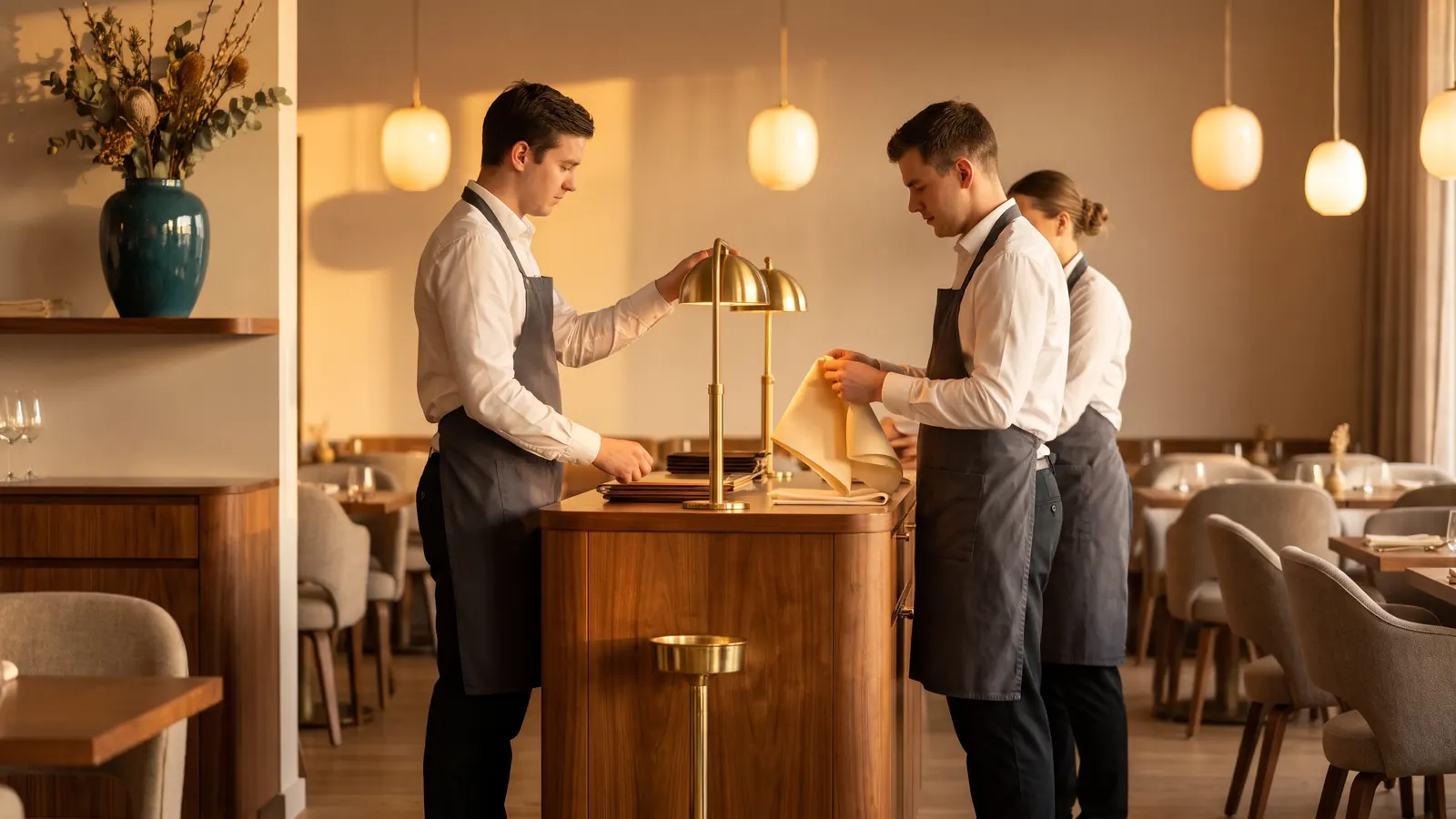
A server dress code does two jobs. It tells guests what kind of night they're in for before anyone says a word, and it tells your team exactly what to wear so nobody's guessing at 4:45 on a Friday. The right look depends on your concept and on how hard your servers work a shift. Below are uniform ideas by restaurant style, what a solid policy covers, and how to keep the look consistent as you hire and grow.
Server Dress Code by Restaurant Style
| Style | Server look | Shoes | Watch for |
|---|---|---|---|
| Fine dining | Tailored vest or jacket, pressed shirt, dark trousers or skirt | Polished black, slip-resistant | Fit and tailoring; spares for spills |
| Upscale casual | Button-down or fitted knit, bistro apron, dark pants | Black, slip-resistant | Apron pockets sized for a server book and pens |
| Casual dining | Polo or tee in house colors, dark jeans or pants, waist apron | Black, closed-toe, slip-resistant | Fabrics that hold up to daily washing |
| Bar and gastropub | Dark shirt or tee, denim or canvas apron | Slip-resistant with good cushioning | Wet floors and splashes; darker colors hide them |
| Counter service and cafe | Tee or polo, cap or headband, short apron | Closed-toe, slip-resistant | Hair restraint rules for anyone handling food |
| Hotel and resort dining | Coordinated by outlet, with one family look across restaurant, bar, and banquets | Polished, slip-resistant | A wide size range and steady reorders |
| Patio and beach | Breathable fabrics, lighter colors, caps where they fit the concept | Slip-resistant, comfortable in heat | Spare shirts for midday changes |
A few things to weigh as you choose:
- Match the check average. A pressed shirt and a long bistro apron set expectations about the bill before the menu does.
- Pick fabrics for the work. Servers carry plates, lean over tables, and reach into a hot window all night. Look for stretch, breathability, and stain resistance.
- Think about the whole team. Servers, bartenders, hosts, and bussers should look like they work at the same place, even when each role wears something a little different.
- Plan for the season. A long-sleeve shirt that works in January is miserable on a July patio. Some groups keep a summer and a winter version of the same look.
Dress the Rest of the Team to Match
Guests see everyone on the floor, and in an open kitchen they see the line too. Build one family look and adjust it by role:
- Hosts can dress a step up from servers, since they're the first person a guest meets.
- Bartenders need sleeves that roll up or stay out of the way, and aprons that handle splashes.
- Bussers and back waiters move fast and carry heavy bus tubs, so give them the same colors in sturdier fabrics.
- Back of house needs chef coats or kitchen shirts, aprons, and hair restraints that meet your health code.
- Valet and door staff need weather-ready layers in the same palette.
What Every Server Dress Code Should Cover
Write the policy down, put it in your handbook, and show new hires a photo of the full look.
- Each piece of the uniform, with colors, and who provides it.
- Shoes, closed-toe and slip-resistant, in a color you name.
- Grooming, including a clean uniform every shift, hair neat and secured, and clean nails.
- Hair and jewelry. Your local health code sets rules for anyone handling food, so follow it, and keep jewelry minimal on the floor.
- Name tags or pins, if you use them, and where they go.
- An out-of-uniform plan. Keep spare shirts and aprons on hand so a forgotten apron doesn't cost you a server for the night.
- Sizing and fit. Offer a full size range and a couple of cuts so everyone has something comfortable for a double.
Spell out the small stuff, too. If aprons get tied in front, if sleeves stay down, or if hats are allowed on brunch shifts only, write it down. A dress code that leaves those calls to each manager ends up enforced four different ways.
Keep It Fair and Legal
Dress codes cause trouble when the rules change from person to person or when they touch on protected traits. A few guardrails help:
- One standard per role. Write rules that apply to everyone in the job.
- Religious dress. Federal law generally requires employers to accommodate religious dress and grooming unless it causes undue hardship.
- Natural hair. Many states have passed CROWN Act laws that protect natural hair textures and protective styles, so keep grooming rules about safety and neatness.
- Who pays. Under federal wage rules, if you require a uniform and employees pay for it, the cost can't push their pay below minimum wage or cut into overtime. Some states go further and require employers to provide or maintain required uniforms.
Have an employment attorney review the policy for your state before it goes in your employee handbook.
Build a New-Hire Kit
A kit that's ready on day one saves a scramble and tells a new hire you planned for them. A typical server kit includes:
- Two or three shirts, so one is always clean
- Two aprons
- A name tag, if you use them
- Care instructions for each piece
- Your shoe requirements, plus a stipend or approved options if you offer them
Hand the kit over at orientation, have the new hire try everything on before the first shift, and swap sizes that day. Keep try-on samples in every size at each location, and record each person's sizes when they're hired so reorders go fast. Set par levels for spares, and replace worn pieces on a schedule so your team doesn't look faded by summer.
Test Before You Switch
Before you order a new look for the whole team, run a wear test. Give a few servers the new pieces for two weeks of real shifts and ask what works: pocket placement, how the fabric handles a slammed Saturday, and whether it survives the wash. Fix what they flag, order spares with the first round, and set one switch date so the whole floor changes over together.
Rent, Buy, or Run a Program
Some operators rent uniforms with laundry included, and others buy uniforms and let staff launder them at home. Each approach has tradeoffs in cost, control, and how well it handles turnover, which we break down in uniform rental vs. buying.
A uniform program goes further. It covers role-based uniforms for front of house, back of house, bar, host, and valet, with sizing, logo work, ordering, new-hire kits, and reorders handled in one place. It keeps the look consistent as you hire, without a manager chasing orders between shifts.
Keep Every Location Matched
Once you're past one location, uniforms drift fast. One GM orders a slightly different apron, a reorder comes in a shade off, and the second location stops looking like the first. Keep a single written spec for each piece, order through one channel, and reorder from the same source so colors stay consistent from one production run to the next. When you open a new location, order its first full round from the same spec, plus spares, well before training starts. A good restaurant uniforms partner holds that spec and handles reorders for every address.
How Monarch Helps
We run restaurant uniform programs for every role, from sizing and logo work to new-hire kits and reorders, and keep every location matched. You approve the look before anything is ordered. For a wider look at your operation and marketing, take our free AI assessment.
Want help with this?
Monarch handles uniform programs for restaurants as part of one white-glove team. We do the work. You guide the process. See how uniform programs works with us.
Get Your Free AI Assessment