
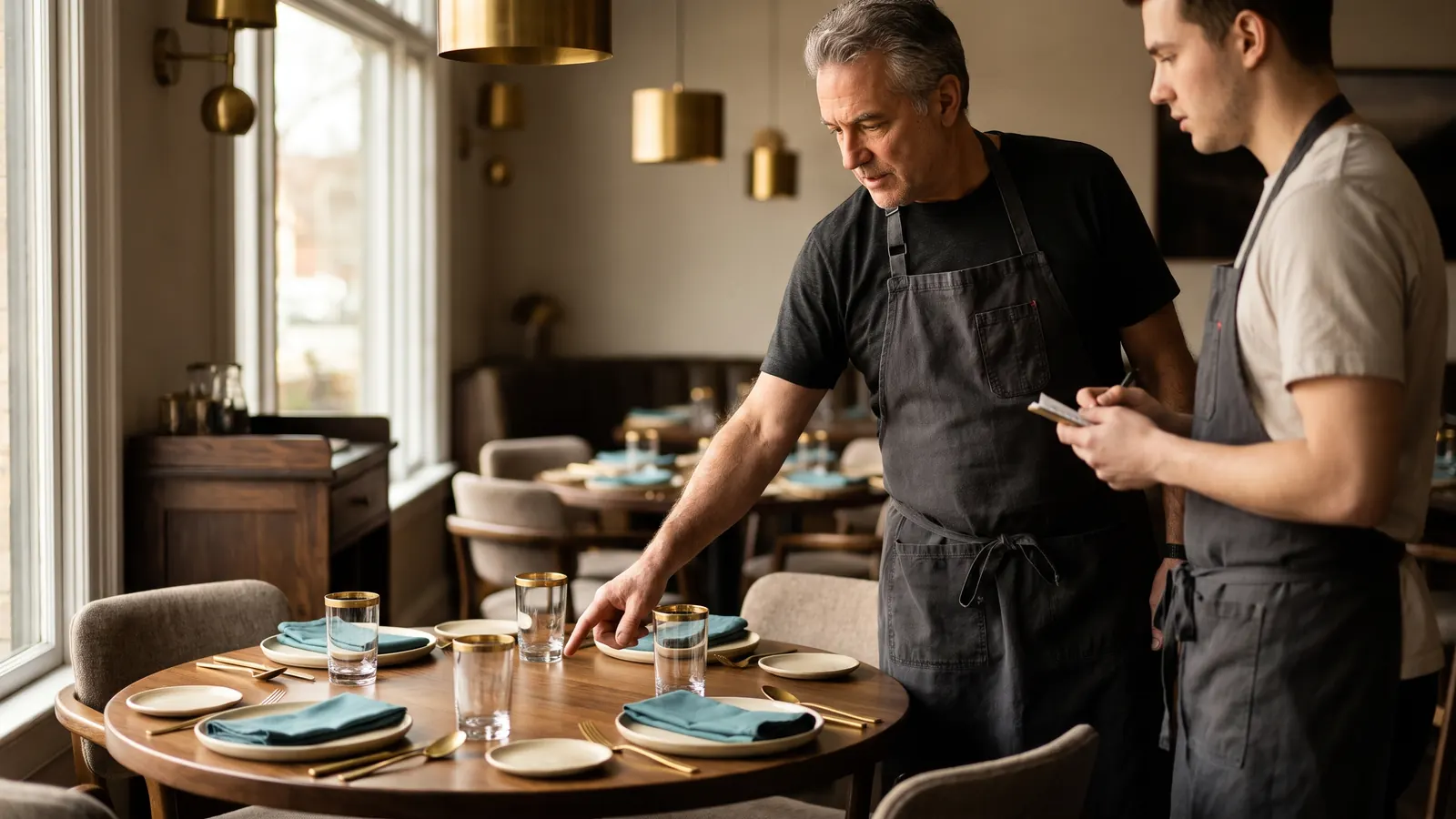
Most server training comes down to a couple of shadow shifts, a menu to study at home, and a busy Saturday where the new hire figures out the rest. Some people make it through that. Others quit before the month is out, and the ones who stay pick up whatever habits their trainer happened to have. A structured first ten days gives every new server the same foundation and gives you a clear way to know who can take a section alone. What follows is the checklist we'd use, day by day, plus what to test along the way.
How the 10 Days Work
Each day has one focus, a short lesson, time on the floor with a trainer, and a quiz at the end. The trainee moves on to the next day only after passing that quiz and getting the trainer's sign-off. Trainers work from the same checklist for every hire, so a server trained in March learns exactly what a server trained in September learns.
This is the structure we use when we build a training academy: role-based tracks, 10 days each, where a daily quiz and the trainer's sign-off open up the next day. Servers, hosts, back waiters, bartenders, and captains each get their own track. The checklist below follows the same general shape, adapted for a typical full-service restaurant.
Server Training, Day by Day
| Day | Focus | Trainee does | Sign-off checkpoint |
|---|---|---|---|
| 1 | The house | Tour, meet the team, uniform fitting, handbook review and signature, shadow pre-shift | Knows table numbers and seat positions; handbook signed |
| 2 | Steps of service | Shadows a trainer for a full shift, from greet to farewell | Walks through every step of service out loud |
| 3 | Menu, part one | Tastes and studies starters and mains, with ingredients, prep, and plating | Passes the quiz on starters and mains |
| 4 | Menu, part two, and allergens | Learns desserts, sides, and specials, plus your allergen chart and flagging steps | Names the allergens in any dish and how to flag them |
| 5 | Beverage | Learns the wine list, cocktails, beer, zero-proof drinks, and alcohol service rules | Recommends a pairing and explains your ID check |
| 6 | POS and checks | Rings orders with modifiers, coursing, splits, payments, voids, and comps | Rings a full mock table without help |
| 7 | Reverse shadow | Runs two or three tables while the trainer follows | Trainer signs off on greet, order accuracy, and timing |
| 8 | Side work and teamwork | Opening and closing side work, running food, working with expo | Finishes side work to standard without prompting |
| 9 | Supported section | Runs a small section on a regular shift, trainer nearby | Manager observes and gives feedback |
| 10 | Final check | Written menu and allergen test, service evaluation, checkout | Trainer and manager sign off; first solo shift scheduled |
Days 1 and 2: The house and the steps of service
First impressions run both ways. Have the new hire's shirts and apron ready, a locker or cubby assigned, and their ten-day schedule in hand before they walk in. Introduce them by name at pre-shift.
Day 2 is about your steps of service, written down once and taught the same way every time: greet timing, the drink order, specials, the check-back, clearing, dessert, the check, and the farewell. If those steps aren't written yet, write them before your next hire starts. Our guide to restaurant SOPs shows how to fit them on one page.
Days 3 to 5: Menu, allergens, and beverage
Servers sell what they've tasted. Feed trainees the menu, have the chef or kitchen lead explain each dish, and ask them to describe every plate in one sentence a guest would understand.
Allergens get their own day because a mistake can hurt someone. The FDA recognizes nine major food allergens: milk, eggs, fish, crustacean shellfish, tree nuts, peanuts, wheat, soybeans, and sesame. Your servers should know which dishes carry each one and follow one process every time: ask the guest, ring it in clearly, tell the kitchen, and confirm with expo when the plate goes out. A trainee who isn't sure should say so and check with the kitchen. Guessing is the habit you train out of them first.
For beverage, cover the list, your pours, and your alcohol service rules, including how to check an ID and how to cut someone off. If your state or your insurer requires responsible alcohol service certification, schedule it in this window.
Days 6 to 8: POS, reverse shadow, and side work
Let trainees practice on the POS in training mode before they touch a live check. Have them ring a full mock table with substitutions, a split check, and a comp that needs a manager.
The reverse shadow on day 7 is where it clicks. The trainee leads and the trainer follows, stepping in only when a guest would notice a problem. Afterward, the trainer gives two or three specific notes the trainee can use on the very next table.
Side work should come from the same written list every shift, so new servers learn your standard on day 8 and keep it.
Days 9 and 10: A supported section and the final check
On day 9, give the trainee a small section on a regular shift with the trainer nearby. A manager watches part of the shift and gives feedback before close.
Day 10 is the final check: a written menu and allergen test, a service evaluation against your steps of service, and a full checkout. When the trainer and manager both sign off, schedule the first solo shift on a slower night with a lighter section. A Tuesday makes a better first night than a Saturday.
What to Test Before a Server Works Alone
- Table numbers and seat positions
- Every step of service, in order
- Every dish, with ingredients, allergens, and a one-line description
- The allergy process from table to kitchen to expo
- Wine and cocktail basics, plus ID checks
- POS skills, including modifiers, coursing, splits, voids, and comps
- Side work and closing checkout
- Who to ask for help, and when
Pick and Support Your Trainers
Pick trainers for how well they teach. You want people who explain things patiently and model your standard at every table. Give them the checklist, a lighter section on training days, and, if you can, a training differential on their pay. Ask for a few notes on each trainee after every shift so the manager can see progress well before day 10.
Keep It Going After Day 10
Training keeps going after the checklist ends. Check in at 30 days. Add a short lesson and quiz every time the menu changes. Run allergen refreshers a few times a year. If part of your team reads Spanish first, offer every lesson in Spanish too.
This is where a dedicated restaurant staff training program pays off. When lessons, quizzes, and sign-offs live in one place, you can see at a glance who's current on the new menu. For the bigger picture, read our guide to building a restaurant training program.
How Monarch Helps
We build server training into a custom training academy written from your menu, your steps of service, and your handbook, with daily quizzes and trainer sign-offs built in. You approve every lesson before your team sees it. To see where training ranks among your biggest gaps, take our free AI assessment.
Want help with this?
Monarch handles training and lms for restaurants as part of one white-glove team. We do the work. You guide the process. See how training and lms works with us.
Get Your Free AI Assessment