
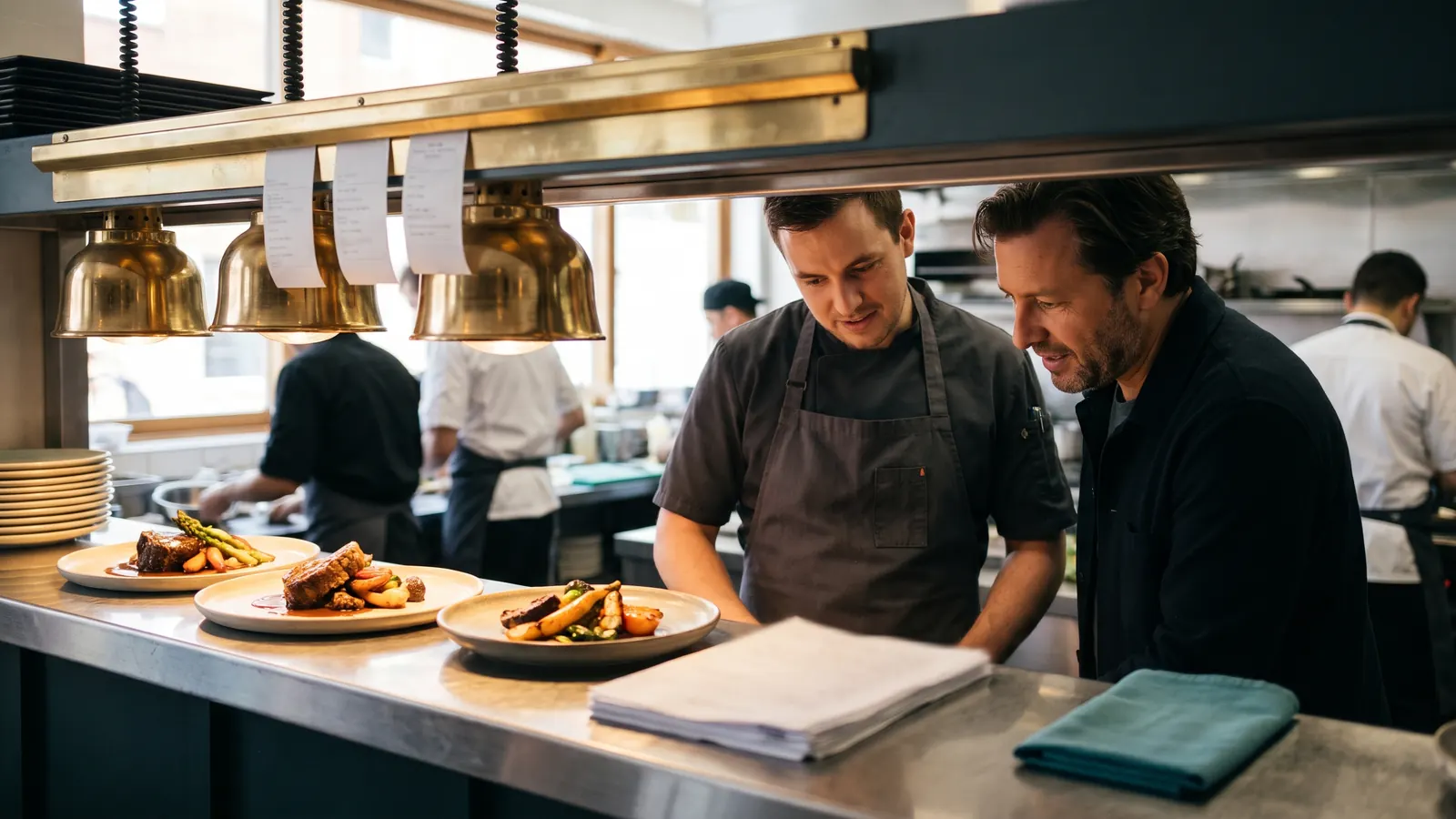
Menu engineering uses two numbers, how much profit each dish brings in and how often it sells, to decide what to promote, reprice, rework, or cut. It's one of the most direct ways to raise profit without adding a single cover, because it works on what guests already order. You need a costed recipe for every dish and a sales report by item from your POS. The rest is arithmetic.
What you need before you start
- Costed recipes. Every dish, with current supplier prices.
- Item sales from your POS. Pull 30 to 90 days, long enough to smooth out one odd weekend.
- Clean item names. If the same dish rings in under three names, combine them first.
- Modifiers and sides. A burger that comes with fries, or a $3 add-on that half of guests choose, changes the plate cost and the price.
The two numbers behind menu engineering
Contribution margin (CM) = menu price − plate cost
Plate cost is the cost of everything on the plate, including sides, sauce, and garnish. If your recipes aren't costed yet, our guide on how to calculate food cost walks through it.
Menu mix percentage = units sold of one item ÷ total units sold in that category
Compare dishes only within a category. Entrees compete with entrees, and appetizers compete with appetizers.
Set the two lines that sort your menu
The classic menu engineering matrix sorts each dish against two benchmarks:
- Profit line. The weighted average CM for the category, which is total CM dollars ÷ total units sold.
- Popularity line. 70 percent of an equal share. With six entrees, an equal share is 1 ÷ 6, or 16.7 percent, and 70 percent of that is about 11.7 percent.
A dish above both lines is a star. High popularity with low CM makes a plowhorse. High CM with low popularity makes a puzzle. A dish below both lines is a dog.
Worked example: six entrees
Here's one month of entree sales at a casual restaurant, in round numbers for illustration.
| Dish | Price | Plate cost | CM | Sold | Mix | Category |
|---|---|---|---|---|---|---|
| Roast chicken | $24 | $7 | $17 | 300 | 25% | Star |
| Short rib | $34 | $13 | $21 | 180 | 15% | Star |
| Salmon | $30 | $11 | $19 | 240 | 20% | Star |
| Burger | $18 | $6 | $12 | 360 | 30% | Plowhorse |
| Mushroom risotto | $22 | $4 | $18 | 60 | 5% | Puzzle |
| Shrimp pasta | $26 | $12 | $14 | 60 | 5% | Dog |
| Total | 1,200 | 100% |
Multiply each dish's CM by its units sold and add them up, and total CM comes to $19,680. Divide by 1,200 entrees and the profit line is $16.40. The popularity line is 11.7 percent. Every dish above $16.40 and above 11.7 percent is a star, and so on down the matrix.
Two lessons jump out. The short rib runs about a 38 percent food cost, one of the highest on the list, yet it's a star because each plate brings in $21. The risotto has the lowest food cost, about 18 percent, and it barely sells. Judged on food cost percentage alone, you'd push the risotto and worry about the short rib. Menu engineering works in CM dollars, and the dollars point the other way.
What to do with each category
| Category | Profit | Popularity | What to do |
|---|---|---|---|
| Star | High | High | Protect it. Keep the recipe and portion consistent, give it prime placement, and test a small price increase. |
| Plowhorse | Low | High | Re-engineer it. Trim a costly side, adjust the portion, raise the price a little, or pair it with a high-margin add-on. |
| Puzzle | High | Low | Sell it harder. Rename it, rewrite the description, move it to a better spot, and have servers recommend it. |
| Dog | Low | Low | Rework it or cut it, unless it does a clear job on the menu. |
Applied to the example:
- Burger, a plowhorse. Guests love it, so keep it front and center and work the margin. A $1 price increase adds $360 a month at the same volume, and a side that costs 50 cents less adds another $180. Together that lifts total entree CM from $19,680 to $20,220 without selling one more plate.
- Risotto, a puzzle. It earns $18 a plate and sells 60 a month. Give it a better description, a better spot, and a server push for 30 days, then check the mix again.
- Shrimp pasta, a dog. The shrimp makes it expensive and guests aren't choosing it. Rework the recipe to bring the plate cost down, or replace it. Keep a dog only when it does a job, like being the one gluten-free entree that keeps a party of six from booking somewhere else.
Pricing moves that hold up
- Raise prices in small steps on stars and plowhorses, and watch the mix for a few weeks after each change.
- Re-cost recipes whenever a supplier price moves, especially proteins.
- Track the weighted CM for the whole category after every change. A price increase that drops a star's volume too far can lower total profit.
- Check plate costs against your food cost target as a guardrail, and make the final call on CM dollars.
Placement and menu design
- Put stars and puzzles where guests look first in each section, such as the top of a list or a boxed feature.
- Keep categories short enough to scan. A shorter list is also easier to cost, prep, and execute.
- Write descriptions with specific ingredients and preparation, and keep them short.
- Many menu designers avoid lining prices up in a column, so guests read the dish before the price.
Get the floor behind the plan
A puzzle stays a puzzle if servers never mention it. At pre-shift, have the team taste the dish you're pushing, give them one plain sentence to describe it, and tell them why it matters. Then track how many each server sells for a few weeks. The same goes for the kitchen: a star only stays a star if the portion and plating hold steady on a slammed Saturday.
Run it on drinks and desserts too
The same math works on cocktails, wine by the glass, beer, and desserts. Beverage lists hide plowhorses and dogs just like entrees do, and a slow bottle on the list also ties up cash in inventory. Run each category on its own, with its own profit and popularity lines.
Mistakes that skew the results
- Comparing dishes across categories, like a side salad against a steak.
- Using a single week of sales, or a week with a holiday or a private event in it.
- Forgetting sides, sauces, and modifiers in the plate cost.
- Cutting a dog without checking who orders it and what else they order.
- Running the analysis once and never again.
How often to re-run it
Run it quarterly, and again after any menu change, price change, or big supplier increase. Seasonal menus get a fresh run at every change. Keep each version, because the trend over a year tells you more than any single month. Menu engineering moves your restaurant profit margins directly, since it changes what every cover earns. It's also one of the first things our restaurant operations consulting team looks at, right alongside prime cost and labor.
How Monarch helps
We run menu engineering as part of our operations consulting, from recipe costing through pricing and placement, built on your own POS sales and your kitchen's recipes. Our free AI assessment is a fast way to spot gaps in your operations and marketing, and Christy follows up personally.
Want help with this?
Monarch handles operations consulting for restaurants as part of one white-glove team. We do the work. You guide the process. See how operations consulting works with us.
Get Your Free AI Assessment