
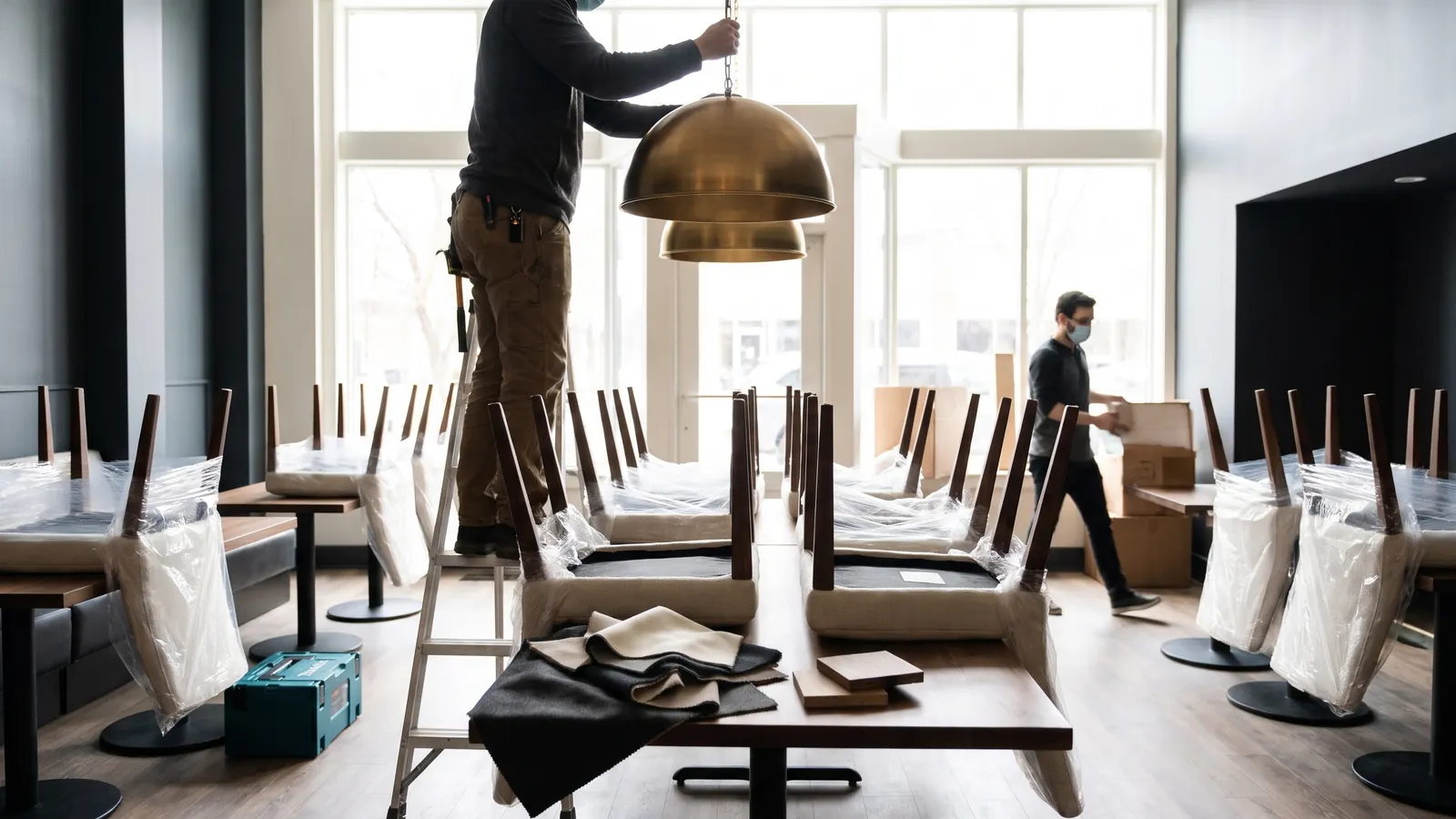
FF&E comes up the moment you start planning a restaurant. Your designer says it, your contractor says it, and it shows up as its own line in your budget. The FF&E meaning is simple: furniture, fixtures, and equipment, the movable items that furnish and equip a space but aren't part of the building itself. The hard part is agreeing on what goes in that line and what doesn't, because the gap between an FF&E budget and a construction budget is where money quietly disappears. Here's what counts, how FF&E differs from OS&E and build-out, and how to budget it so the number holds.
FF&E meaning: what counts in a restaurant
- Furniture: dining chairs, tables and bases, bar stools, freestanding booths, lounge seating, host stands, and patio furniture.
- Fixtures: decorative items you could remove without damaging the building, like pendant lights, sconces, mirrors, artwork, and window treatments.
- Equipment: depending on the project, this can include kitchen and bar equipment, though many restaurant budgets give kitchen equipment its own line.
Definitions vary by designer, lender, and lease. What matters is that everyone on your project works from the same list.
FF&E vs. OS&E vs. build-out
| Category | Restaurant examples | Usually budgeted as |
|---|---|---|
| Furniture | Chairs, tables, bar stools, freestanding booths, patio sets | FF&E |
| Loose and decorative fixtures | Pendants, sconces, mirrors, art, window treatments | FF&E |
| Kitchen and bar equipment | Ranges, fryers, reach-ins, ice machines, glass washers | Its own equipment line, or FF&E, by project |
| Built-ins | Millwork bars, built-in banquettes, hood systems, plumbing, HVAC | Construction and build-out |
| Operating supplies (OS&E) | Plates, glassware, flatware, linens, pans, uniforms | OS&E or smallwares |
OS&E stands for operating supplies and equipment, the things your team uses up, breaks, or replaces regularly. Built-ins are attached to the building, so they belong in the construction budget, and under many leases they stay with the space when you leave.
Who buys and installs what
On most projects, every item gets one of three tags:
- OFOI (owner furnished, owner installed): you buy it and your team or vendor sets it up, like loose chairs and tables.
- OFCI (owner furnished, contractor installed): you buy it and the contractor installs it, like decorative light fixtures the electrician hangs.
- CFCI (contractor furnished, contractor installed): it's part of the construction contract, like a millwork bar.
Put a tag on every line. It's the simplest way to prevent the classic gap where everyone assumed someone else ordered the bar stools.
Check your lease while you're at it. Tenant improvement allowances are usually written for permanent improvements, so confirm whether any of yours can go toward furniture or equipment before you count on it.
How to build an FF&E budget
Your restaurant floor plan drives the list, since the table mix sets how many tables, chairs, and stools you buy. Start room by room: dining room, bar, patio, private dining, host area, restrooms, and staff areas. For each item, record the quantity, the unit cost from a written quote, and the lead time. Then add the costs that product quotes often leave out.
FF&E budget = product quotes + freight and delivery + receiving, storage, and install + sales tax + contingency
Here's a worked example with round placeholder numbers. Use your own quotes and your local tax rate.
| Line | Amount |
|---|---|
| Furniture and lighting quotes | $100,000 |
| Freight and delivery | $8,000 |
| Receiving, storage, and installation | $6,000 |
| Sales tax at 7% of product | $7,000 |
| Subtotal | $121,000 |
| Contingency at 10% | $12,100 |
| Total FF&E budget | $133,100 |
The quotes said $100,000. The real budget is about a third higher. For an 80-seat room, that works out to about $1,664 per seat ($133,100 ÷ 80), a handy number for comparing options. Tax rules vary by state, and some states tax freight, so confirm the details with your accountant.
Items owners often forget
- High chairs and booster seats
- Patio umbrellas, heaters, and windscreens
- Waiting area seating and a coat rack
- Server stations and bus carts
- Restroom mirrors, baby changing stations, and accessories
- Trash and recycling receptacles in guest areas
- Staff lockers and break room furniture
Track every piece on an FF&E schedule
Designers and procurement teams track FF&E on a schedule, a spreadsheet with one row per item. Even on a small project, it keeps orders from getting lost between the designer, the contractor, and you. At a minimum, track these columns:
| Column | Why it matters |
|---|---|
| Item code and room | Ties each piece to the floor plan |
| Description, finish, and fabric | Keeps the wrong version from being ordered |
| Quantity, including attic stock | Covers spares for repairs |
| Unit cost and extended cost | Keeps the budget current as quotes change |
| Lead time and order date | Shows what has to be ordered first |
| Ship, delivery, and install dates | Lines up with the construction schedule |
| Install tag (OFOI, OFCI, or CFCI) | Makes it clear who installs each piece |
| Status | Quoted, approved, ordered, shipped, received, or installed |
Review the schedule in every owner meeting. The items with the longest lead times get approved first, even if they aren't the most exciting decisions on the list.
Commercial grade, samples, and lead times
- Buy commercial or contract grade. Restaurant chairs get dragged, stacked, leaned back on, and wiped down with strong cleaners every day. Residential furniture isn't built for that.
- Test samples in the space. Sit in the chair at the table for a full meal. Check seat height against table height, armrests against table aprons, and how the fabric holds up to the cleaner your team actually uses.
- Ask about code requirements. Find out what fire-safety standards apply to upholstered seating in your area, and get the product's ratings in writing.
- Get lead times in writing. Custom and imported pieces take longer than stock items. Build freight, receiving, and install into the construction schedule so furniture doesn't arrive before the floors are finished or after the soft opening.
- Order attic stock. A few spare chairs and extra yards of fabric make repairs easy when a seat gets torn in month three.
Plan for replacement after you open
FF&E wears out, and replacing a dining room's chairs all at once is a big, unplanned check. Hotels handle this with an FF&E reserve. Hotel management agreements commonly set aside around 4 percent of gross revenue for replacing furniture, fixtures, and equipment.
Few independent restaurants formalize a reserve, but a monthly set-aside works the same way. If a restaurant with $1.5 million in annual sales puts away 2 percent, that's $30,000 a year for refinishing tables, reupholstering booths, and replacing worn chairs before guests start noticing. When it's time to replace pieces, the same process applies as opening day: samples, written quotes, lead times, and install timing that works around service. Our commercial restaurant furniture sourcing covers replacements as well as new rooms.
For taxes, talk to your CPA about how your FF&E will be depreciated or expensed. The answer depends on your situation, and rules like Section 179 and bonus depreciation change.
Where FF&E fits in your opening budget
FF&E is one line among many. Build-out, kitchen equipment, smallwares, licenses, pre-opening payroll, and working capital all compete for the same dollars, and FF&E is an easy place to cut when construction runs over. Protect it with its own contingency, and decide early which pieces guests touch most, like chairs and tables, so those get the budget first. For the full picture, see how much it costs to open a restaurant.
If you're already open and wondering what guests notice about your room, get your free AI assessment. Our AI reviews your answers, your Google listing and reviews, and your website, then emails you an evaluation of operations and marketing gaps.
How Monarch helps
We handle FF&E procurement from the floor plan and table configuration to samples, ordering, freight, and install timing, working with your designer and builders and drawing on our vendor network or the vendors you already use. You see every piece before it's ordered, and you approve the plan before anything starts.
Want help with this?
Monarch handles furniture and ff&e for restaurants as part of one white-glove team. We do the work. You guide the process. See how furniture and ff&e works with us.
Get Your Free AI Assessment